If there’s anything an anime, manga, or comic enthusiast can appreciate, it’s a well-written origin story. There’s no better feeling than being hooked to a story right from the get-go. Every once in awhile, a story grips me so tightly, so profoundly, that I just have to talk about it to someone, anyone who will listen. I present to you all Chapter One, my way-too-in-depth analysis of anime origin stories. (I’ll probably make this an ongoing thing if you all dig it, I already have ideas for anime, manga, and comics).
There’s no better way to kick this off than with one of my favorite currently-running series: My Hero Academia. Kohei Horikoshi’s love letter to western superhero comics has exploded in popularity over the last couple of years, especially since the beautifully animated, Bones-produced anime aired from April to June of this year. The series features a rather large ensemble cast, chock full of lovable characters ranging from the fiery Bakugo to the sweet, innocent Ochako. Most of these characters (at least as far as I’ve gotten in the manga) have been given great backstories, but make no mistake, this is an Izuku Midoriya story. Chapter 1 of this manga (and in parallel, the first 2 episodes of the anime), rightfully titled “Izuku Midoriya: Origin”, is brilliant, as Horikoshi checks all the right boxes in creating not only a compelling character, but an engaging universe for his readers to fall into.
*SPOILER WARNING* - If you haven’t read this manga and want to, might not be a great idea to read this. I think it serves as a decent intro to the series, though. So maybe read it anyway, who knows.
ALSO, I’ve only read as far as the printed English manga has been translated (Volume 5), so please don’t spoil anything from after that point on in the comments for me; I’d really appreciate it!
Page One - Establishing Your MC
Literally, figuratively, metaphorically, what have you, it all starts on page 1. A disjointed and out-of-place page 1 can alienate a reader for a long time, so care must be taken in introducing your readers to your story. MHA is a character driven series; everything flows through or around Izuku Midoriya, “Deku”. Starting this series any way other than hearing from Midoriya himself is a mistake, one that Horikoshi avoids. In situations like this, I like to pretend that I know absolutely nothing about the series and am seeing this all for the first time. Here is page 1 of the manga (technically page 5 in the printed Viz version I read this in):
http://manga.famatg.com/read/my_hero_academia/en/0/1/page/3
(like I said, I’m using the official Viz translation, but the best thing I could find online is the Fallen Angels scans, so bear with me)
We learn so much about Deku here in such a small amount of space. After a sweeping shot, intended to establish the setting for the reader (a residential area), we see a trembling, young boy mustering all of his courage to protect an even younger kid who’d clearly been bullied. We then see the bully, referring to the boy as “Deku the quirkless wonder”. In a span of three panels, we’ve learned that the boy is Deku (or at least his nickname is “Deku”; the meaning of the name doesn’t shine through for us English-speaking fans quite yet) and he doesn’t have a quirk, whatever that means. File that part away for a second, I’ll get to that. The bully, shooting fire from his hand and surrounded by a winged-boy and a kid with elongated hands, then taunts Deku, making fun of him for trying to “play hero”. Deku then posits for us in narration as he’s punched by the bully, “People are not created equal. That’s the hard truth I learned at age 4.” From this we can gather that being quirkless is a bad thing, but despite this Deku continues to protect the young kid despite these bullies who possess huge advantages over him. Deku has heart, practically to a fault.
Since the quirkless insult is coming from a boy shooting fire out of his hands, we can assume that a "quirk" can be synonymous with superpowers. On top of explaining part of the world to us, this makes me feel for Deku right off the bat. This kid so desperately wants to be a hero, someone that can protect the innocent, but so clearly lacks the natural ability to do so. This is Deku’s central struggle throughout the entire series: he lacks the talent to be the hero and must constantly push himself to the brink just to achieve the kind of results that come easy to someone like Bakugo. I immediately care about this character and am interested in his growth in the span of a page.
World-Building
In a series as ambitious as MHA, it is important that the author establishes for the reader right away what exactly is going on. There are three ways that this initial, world-building stage can go: too wordy, too vague, or just right. Horikoshi balances this line masterfully, leaving just the right amount of mystery to go along with his world-explanation. I’m now going to transcribe the narration from page 9 of the manga:
“It all began in Keikei City in China with the news that a bio-luminescent baby was born! After that, ‘exceptional individuals’ began popping up all over the world. The cause was unclear. Time passed… and the ‘exceptional’ became the norm. Fantasy became reality! At present 80 percent of the world’s population consists of superhumans with special abilities. The world is in chaos! And a profession that everyone once only dreamed about entered the spotlight!”
You may be thinking that this leans more towards the “too wordy” side of the spectrum, and you’d be perfectly justified in having that opinion. To me, the careful way in which Horikoshi chooses his words makes up for this, as well as how he uses the visuals on the page to enhance what he’s saying. Again, I’m going to show you the Fallen Angels scanlation version of the page, so the words are different from what I transcribed above, but here’s what the panels look like:
The panel that contains “Fantasy… became reality!” is a strong one; it contains clearly menacing figures behind the narration. The words “fantasy became reality” probably sounds positive to most people, but Horikoshi makes a point of it to show us that the spontaneous appearance of quirks has had negative effects on society as well. He then implies that superheroes now exist as a legitimate career choice, specifically to combat these quirked people who are up to no good. In simpler terms: Horikoshi lets us know right away that there are bad guys, but also good guys who are obligated to protect those who can’t protect themselves. Again, he does this all in one page without having to shove information down our throats.
I’ve now done two close-readings of two pages, and written a ton. So I’m going to talk about some of the more fun stuff now.
ACTION
After the first page, we have Kamuy Woods generally being awesome against a giant bad guy:

Then Mt. Lady swoops in for the finisher:

After some exposition, Horikoshi gives shonen fans what they want: some dope action sequences and heroes being awesome. You can’t start an action shonen with some action within the first ten pages or so. We also get a bit more information when Mt. Lady proclaims, “This is my debut!” We can surmise from this that heroes have to go through some kind of application/training process before being able to fight. She already has a nice costume, a hero name, and Kamuy Woods appears to know who she is, so she must have gone through some kind of initiation. We then get some more exposition, and I’ve already gone over how good Horikoshi is at that, so let’s move forward a bit to All Might’s first appearance (couldn’t find a good gif of this moment, so I went with the Fallen Angels scans again):
The amount of power he displays is ridiculous, especially considering the juxtaposition between him and Deku (who idolizes him, btw). That ought to sum up the great action from the first chapter, but there is also some great stuff in Bakugo’s fight with the slime monster.
Hope for the Future
There is bit of a blueprint for writing battle-shonen. Introduce your MC, introduce a different character with exceptional abilities, and prove to your audience how feeble your MC is at the beginning. Naruto and Black Clover (two series that I’d love to do a Chapter One analysis of in the future, btw) are the quintessential examples of this for me. For every Naruto, there’s Sasuke. For every Asta, there’s a Yuno. Deku has Bakugo, like we saw earlier in the chapter.
Horikoshi proves this to us right off the bat: Deku is weak, and there are plenty of strong people his age, like Bakugo. It’s easy to show us that Deku is weak compared to pro heroes like All Might, but it is important to establish that he’s weak even compared to his peers. So that moves into the next step of this blueprint: give the MC a mentor that inspires hope. Naruto has Iruka and Kakashi. Asta has Yami. Deku has All Might.
It is very important after the author makes his main character seem so weak, that he shows that there is hope for him yet. There’s no better way than this:
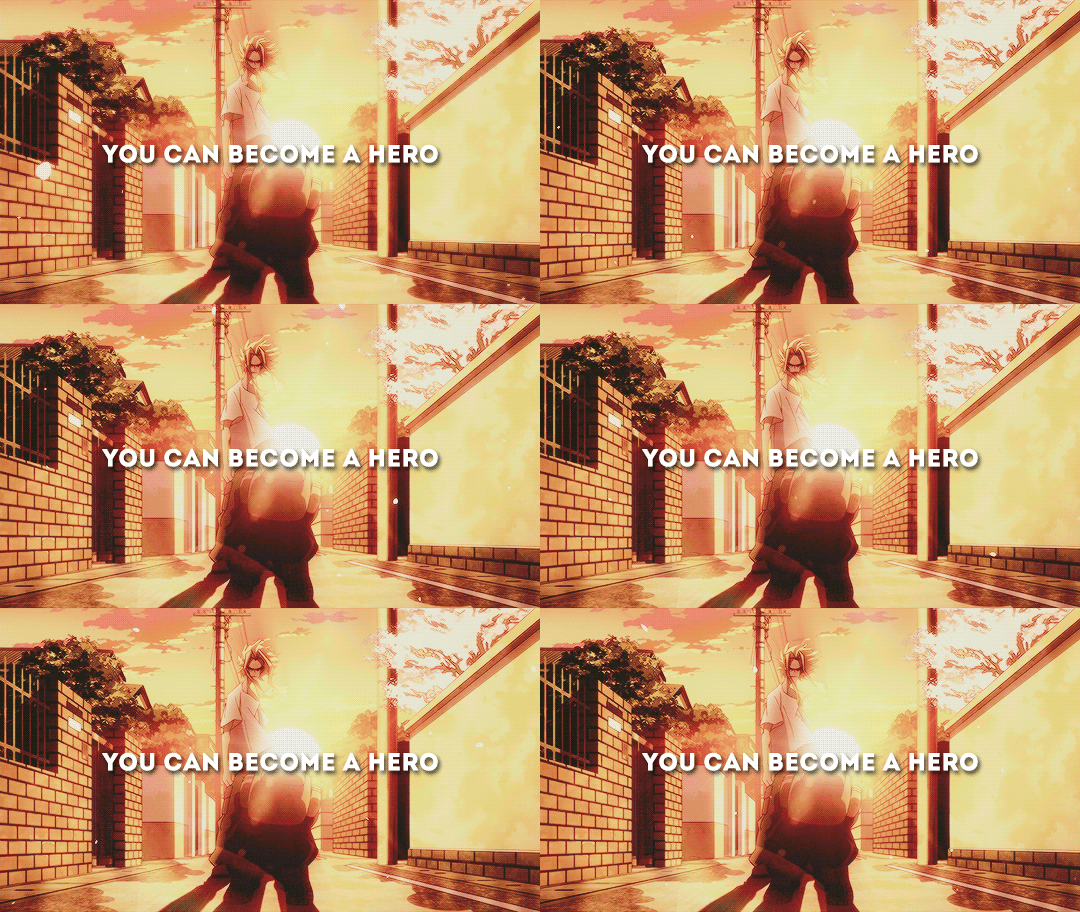
A hero of All Might’s stature telling Deku that he can be a hero is monumental for Deku’s character development, and it’s tough to not be moved by what follows:
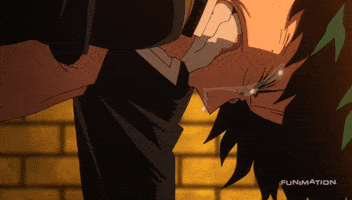
I want to see what Deku can do. I want to believe in All Might, who believes in Deku. Horikoshi has given me enough to keep me invested, while leaving enough mysterious that I want to read more. It’s a brilliant opening to a great series and I highly recommend checking it out if you haven’t yet.
Like I said earlier, I’ll keep doing these if you all like it. Just kinda testing the waters with this first one. If I do another, the next one will probably be on either Naruto or Black Clover!

No comments:
Post a Comment